Travel Stories
Going on a Retreat Alone: What It's Actually Like
✓ Key Takeaways
- •Solo guests are not the exception at most retreats, they are the majority, often 50 to 80 percent of attendees
- •The first shared meal is the hardest moment, and it typically only lasts one evening
- •Going alone often means a deeper, more flexible experience than going with a friend or partner
- •Shared rooms suit those who want a built-in companion; private rooms suit those craving a door to close
- •A good retreat is one of the safest ways to travel solo, with staff, structure, and a group from day one
- •Small groups, communal meals, and daily structure are the strongest signals of a solo-friendly retreat
Somewhere between finding a retreat you like and actually booking it, most people hit a wall. I want to go, but I'd be going alone. Is that weird? Will everyone else show up with a partner, or a pack of college friends, while I push rice around my plate and pretend to be fascinated by my tea?
No, and the numbers back it up: depending on the retreat, half to eighty percent of guests arrive solo.
But a statistic never killed a fear, so here's what actually happens when you go on a retreat by yourself: the good parts, the awkward twenty minutes, and the stuff no brochure will admit.
Everyone Is Thinking the Same Thing You Are
Here's what surprises first-timers most. That worry about being the only one alone? A lot of the other guests carried the same worry through the same door. One guest had just quit a job. Another was coming out of a divorce that wasn't quite finalized yet. A third had burned out badly enough that a doctor used the word mandatory, and a fourth just got tired of waiting on a friend's calendar to cooperate. Turning points produce solo travelers.
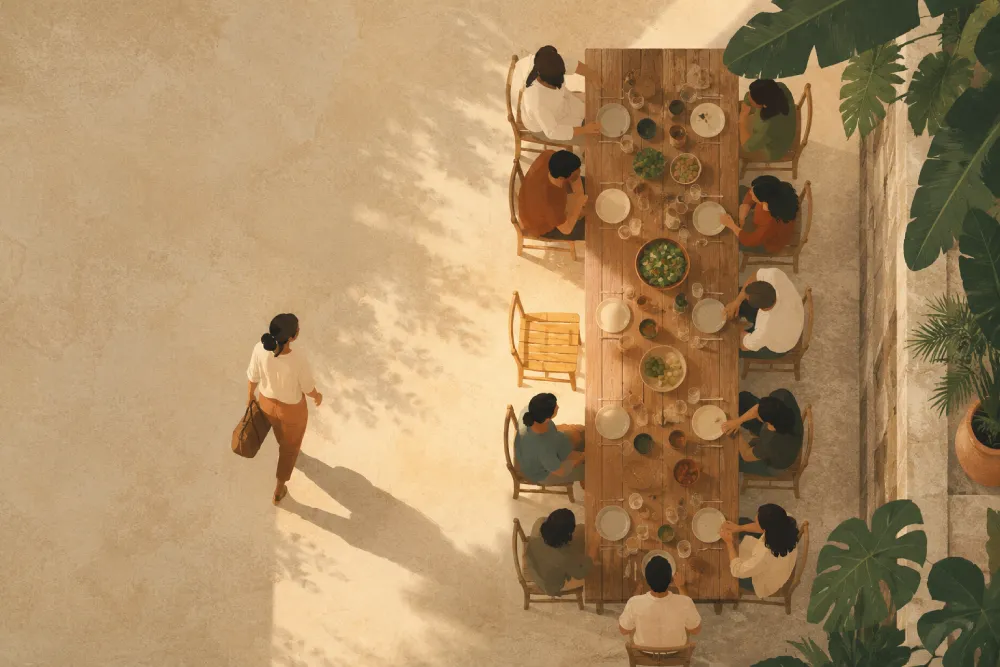
At that first dinner, the room isn't full of tight friend groups. It's a dozen or so people who walked in solo not long before you, each one hoping somebody else speaks first. Usually gone by the second meal.
The First Dinner Is the Hardest Part, and It Lasts One Evening
Let's name the moment people actually dread: the first shared meal. You walk in knowing nobody, and there's a table of strangers waiting. Genuinely a bit uncomfortable. No point pretending otherwise.
Retreats plan around this moment on purpose. Shared meals, communal seating, usually a welcome circle the first evening. Within an hour someone asks where you flew in from. By dessert you know who's from Melbourne, who's on her third visit, who nearly missed the connection in Doha. The retreat does the social heavy lifting so you don't have to.
Being Alone Is Actually the Easier Way to Do a Retreat
We're a booking platform, so take that with a grain of salt if you want. Hosts who've watched hundreds of guests come and go tend to say the alone-versus-together question basically answers itself by day two. Here's the reasoning behind it anyway.
Come with a friend or partner and your existing dynamic comes with you. You sit together, process everything together, trade opinions on whether the food's any good and whether the teacher knows what she's doing. Nice enough, but you end up experiencing the retreat through the filter of that relationship, stuck in whatever role it assigned you years ago.
Come alone and nobody at the table has you filed as anything. Not the responsible one, not the funny one, not the one who books the taxis. For a week you're just a person. We hear some version of this from guests a lot. The ones who came alone tend to go deeper and connect more with the group, with nobody there anchoring them to their normal life.
There's a practical side too. Skip the afternoon session and sleep if you want. Sit with a book instead of joining the excursion. Nobody's disappointed, because there's nobody to disappoint.
The Honest Part: What Can Feel Hard
A few things catch solo guests off guard, so it helps to know them going in.
Free time can drag at first. Most retreats leave afternoons open, and if you normally fill every silence with your phone or another person, two unscheduled hours feel strange for a day or two.
Emotions come up too. Yoga, meditation, actual sleep, no laptop: that combination surfaces things you've been too busy to feel. Sounds worse doing that around strangers than it actually is. Worth expecting anyway.
Shared Room or Private Room?
Most retreats offer both. There's no universally wrong answer, only a wrong answer for you specifically.
A shared room costs less and comes with a built-in companion, which plenty of solo travelers love. Fastest way to make a friend on the property. The tradeoff is privacy: someone else's alarm, the small diplomacy of shared shelf space.
A private room costs more. It buys you a door that closes, which matters more than people expect around day four.
Is It Safe to Travel to a Retreat Alone?
For a lot of solo travelers, and for women especially, this question sits underneath every other one. It deserves a straight answer.
Compared with backpacking into a new city on your own, retreats are pretty straightforward. You're sleeping in the same place every night, the staff know who you are, and if you don't show up one morning, someone tends to notice. Most arrange airport pickup too. It's not risk-free, but it doesn't feel like you're entirely on your own either.
Do your homework anyway, same as any trip. Read recent reviews. Check how long the place has been running. Message the host with a question before you book and see how they answer.
How to Pick a Retreat That Is Good for Solo Travelers
Not every retreat suits solo guests equally. Here's what to look for when you browse.
Group size matters more than people think. Somewhere around eight to twenty guests tends to work best. Much bigger than that, and it gets easier to disappear into the crowd.
Shared meals matter more than almost anything else on the page. Communal tables make connection close to automatic. If guests eat separately or wander into town on their own, you'll work a lot harder for company.
A daily schedule helps as well, classes and meals and maybe a group excursion, since those give you a reason to end up near the same people twice. A few retreats out there are really just a nice hotel with a yoga mat bolted on, and solo guests tend to notice that fast.
Read the reviews with one question in mind: do past guests mention coming alone? When several say some version of I came by myself and left with friends, that's your place.
The Real Question Is Not Whether It's Weird
Nobody comes back from a solo retreat calling it weird. Worst case, the first evening felt a little awkward. Best case, and this is the common one: I should have done this years ago.
A lot of people just wait. For a friend to commit, a partner to get interested, calendars to somehow line up. Years can go by like that.
Ready to stop waiting? Browse retreats on Retreator and read the guest reviews. Count how many begin with the words I went alone.