Yoga & Meditation
Vipassana Meditation Retreat: What to Expect (An Honest Guide)
✓ Key Takeaways
- •Vipassana is not a relaxation retreat. It is ten days of intensive self-observation: 4am wake-ups, roughly ten to eleven hours of daily sitting, and complete noble silence throughout.
- •Five precepts are mandatory for the full ten days: no killing, stealing, sexual activity, lying, or intoxicants. They exist to reduce mental friction, not as moral rules.
- •Noble silence means no speaking, eye contact, gestures, or written notes with other students. Most people find it strange for three days and then genuinely peaceful.
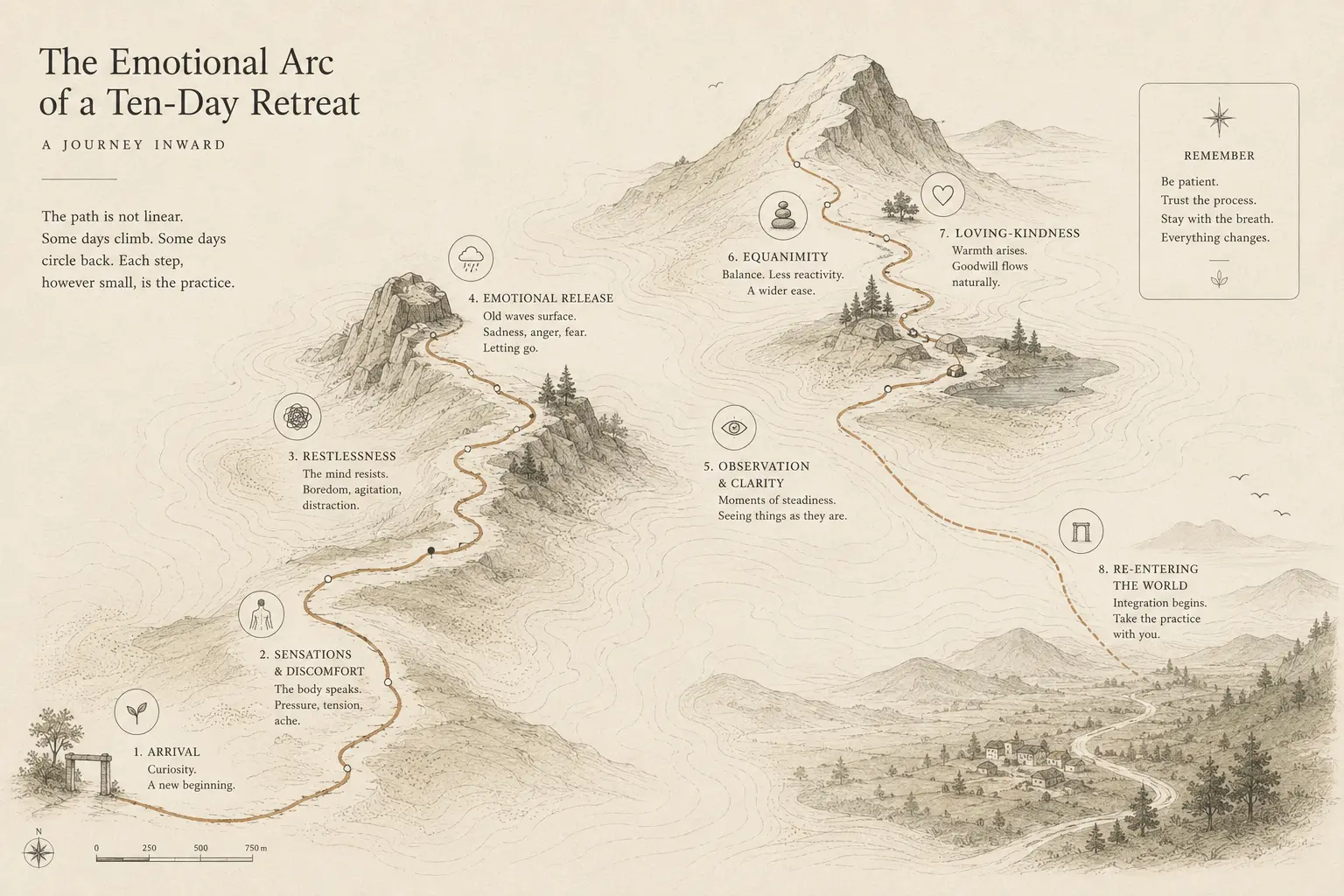
- •Emotional surfacing is expected and normal. Old grief, unexpected clarity, and waves of restlessness are standard features of the middle days.
- •Courses at official Dhamma centres are completely free for first-time students. Food, accommodation, and instruction are covered by donations from graduates.
- •The practice continues after the retreat at one hour morning and one hour evening. How consistently you maintain it is the main variable in whether the experience has lasting impact.
So you have heard about Vipassana meditation retreats. Maybe a friend came back from ten days of silence looking oddly calm, or you stumbled across it while researching meditation retreats. Either way, you are curious, a little intrigued, and possibly a little scared. That is completely normal.
This guide will walk you through everything you actually need to know before you go, including what the five rules of Vipassana are and why they matter more than you might think.
What Is a Vipassana Retreat?
Vipassana is one of the oldest meditation techniques in the world, rooted in the Theravada Buddhist tradition. The word itself means "to see things as they really are." In modern times, the most well-known form of Vipassana is taught by S.N. Goenka, and courses run at Dhamma centers around the world, most of them completely free of charge. You do not pay to attend, only donate at the end if you choose to.
The standard course is ten days. Ten days of silence, early mornings, and sitting with your own mind. It sounds extreme, and honestly, it is. But people keep coming back, which tells you something.
What Are the Five Rules of Vipassana?
Before you even sit down to meditate, you are asked to follow five precepts for the entire duration of the retreat. These are non-negotiable. They are called the Pañca-sila, or five moral precepts, and they form the ethical foundation that makes the practice possible.
- Abstain from killing any living being. This includes insects. You will not be swatting mosquitoes during your ten days, though most people quietly compromise on that one. The intent here is to cultivate an attitude of non-harm toward all life.
- Abstain from stealing. Straightforward enough. Taking what is not offered to you is off the table, even something small.
- Abstain from all sexual activity. The retreat is a space for turning inward. Sexual energy, when redirected toward practice, becomes a resource rather than a distraction.
- Abstain from telling lies. This one pairs naturally with the noble silence rule. When you are not speaking, there is very little opportunity to lie. But it extends to written communication and gestures too.
- Abstain from all intoxicants. No alcohol, no cannabis, no recreational drugs. Your mind needs to be clear and unmedicated for the technique to work properly. Some centers also ask you to stop caffeine beforehand, though most serve tea and coffee at meals.
These five rules are not arbitrary. They reduce the friction in your daily life at the center so that mental energy is not being burned on guilt, temptation, or social drama. The less noise in your external life, the more clearly you can hear what is happening inside.
The Daily Schedule (And It Is Brutal)
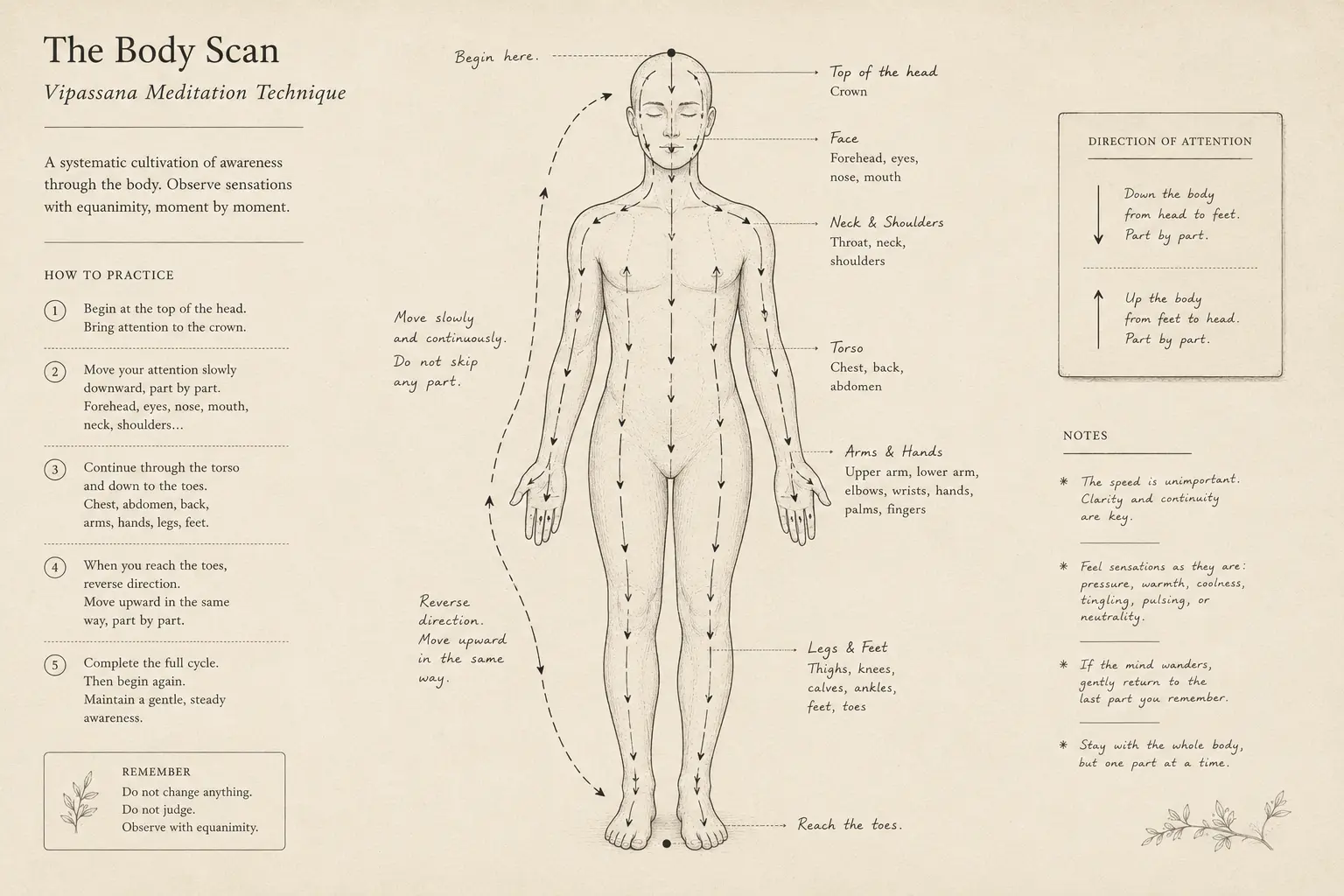
Knowing the schedule in advance helps. Nothing quite prepares you for it emotionally, but at least you will not be surprised.
The bell rings at 4:00 AM. Meditation begins at 4:30. You will sit in the main hall or in your room. Breakfast is at 6:30. More meditation. Lunch at 11:00. The afternoon is ten to eleven hours of sitting each day in a ten-day silent retreat. A short break around 5:00 PM for tea (and fruit for new students). Evening discourse at 7:00. More sitting. Lights out at 9:30.
For the first few days, most people find it physically uncomfortable before it becomes mentally uncomfortable. Your back will hurt. Your knees will ache. Your mind will create elaborate reasons why you should leave.
Most people do not leave.
Noble Silence: What It Is Actually Like
"Noble silence" means no communication with other students. No talking, no eye contact, no notes passed at breakfast. You are, for all practical purposes, alone in a crowd.
At first this feels deeply strange. By day three or four, most people find it genuinely peaceful. You stop performing yourself for others. You stop tracking what other people think of you. Without conversation to fill the gaps, you start noticing things: the quality of light in the afternoon, the sound of wind, the texture of your own thoughts.
Teachers and course managers are available if you need them. You are not completely sealed off. But the silence between students is maintained strictly, and breaking it is considered disruptive to the group energy.
The Technique Itself
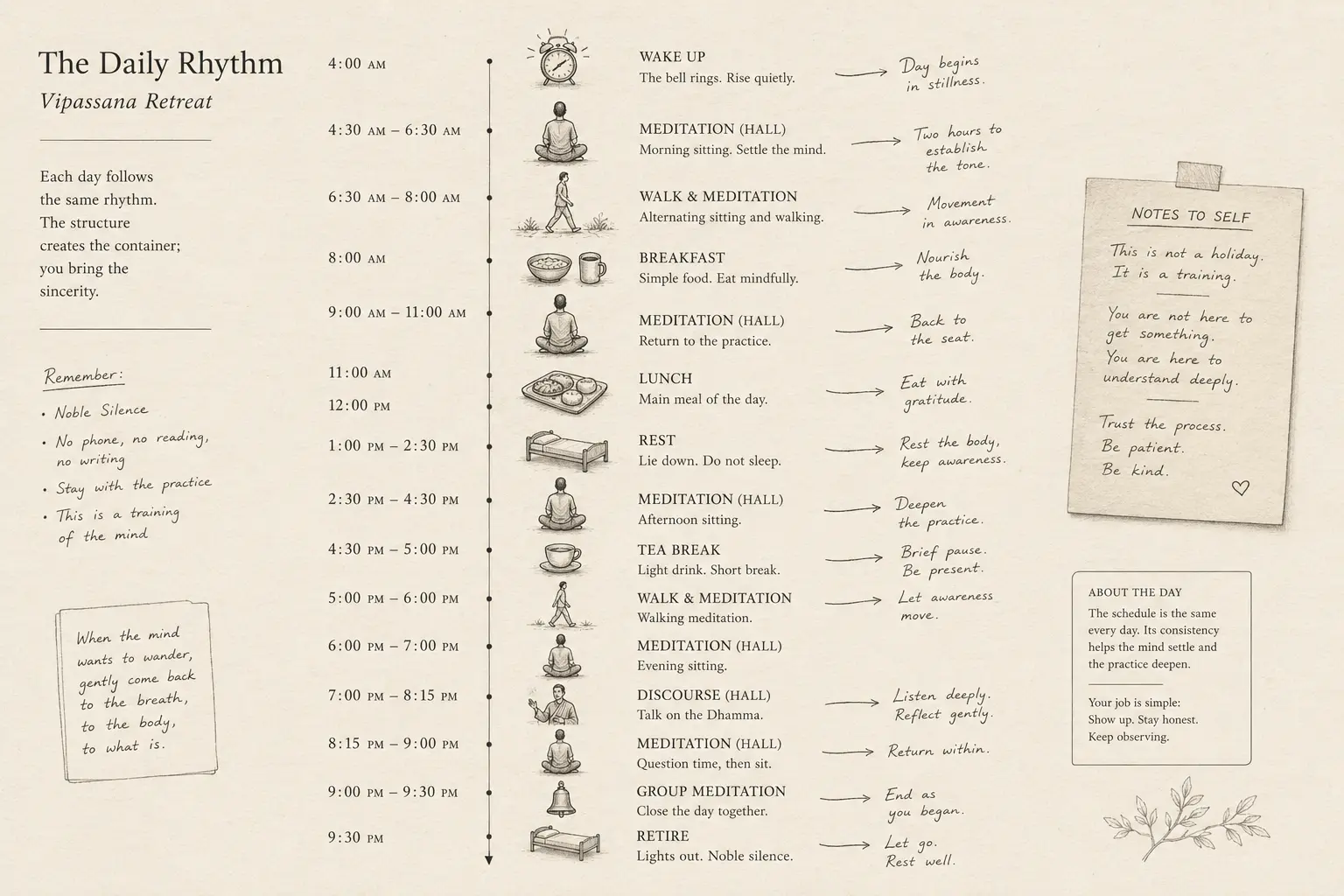
For the first three days, you practice Anapana: focused awareness on the breath and the sensations around the nostrils. This is purely to sharpen the mind. Think of it as calibrating an instrument before you use it.
On day four, the actual Vipassana technique is introduced. You systematically scan your body from head to feet and back again, observing physical sensations without reacting to them. The goal is to develop equanimity: the capacity to observe what arises without craving pleasant sensations or pushing away unpleasant ones.
This sounds simple. It is not simple. The practice is revealing precisely because it shows you how reactive you are, how quickly the mind reaches for comfort and flinches from discomfort. Sitting with that pattern, again and again, starts to loosen it.
On day nine, Metta, or loving-kindness meditation, is introduced as a way to share the merit of the practice with others.
What Comes Up Emotionally
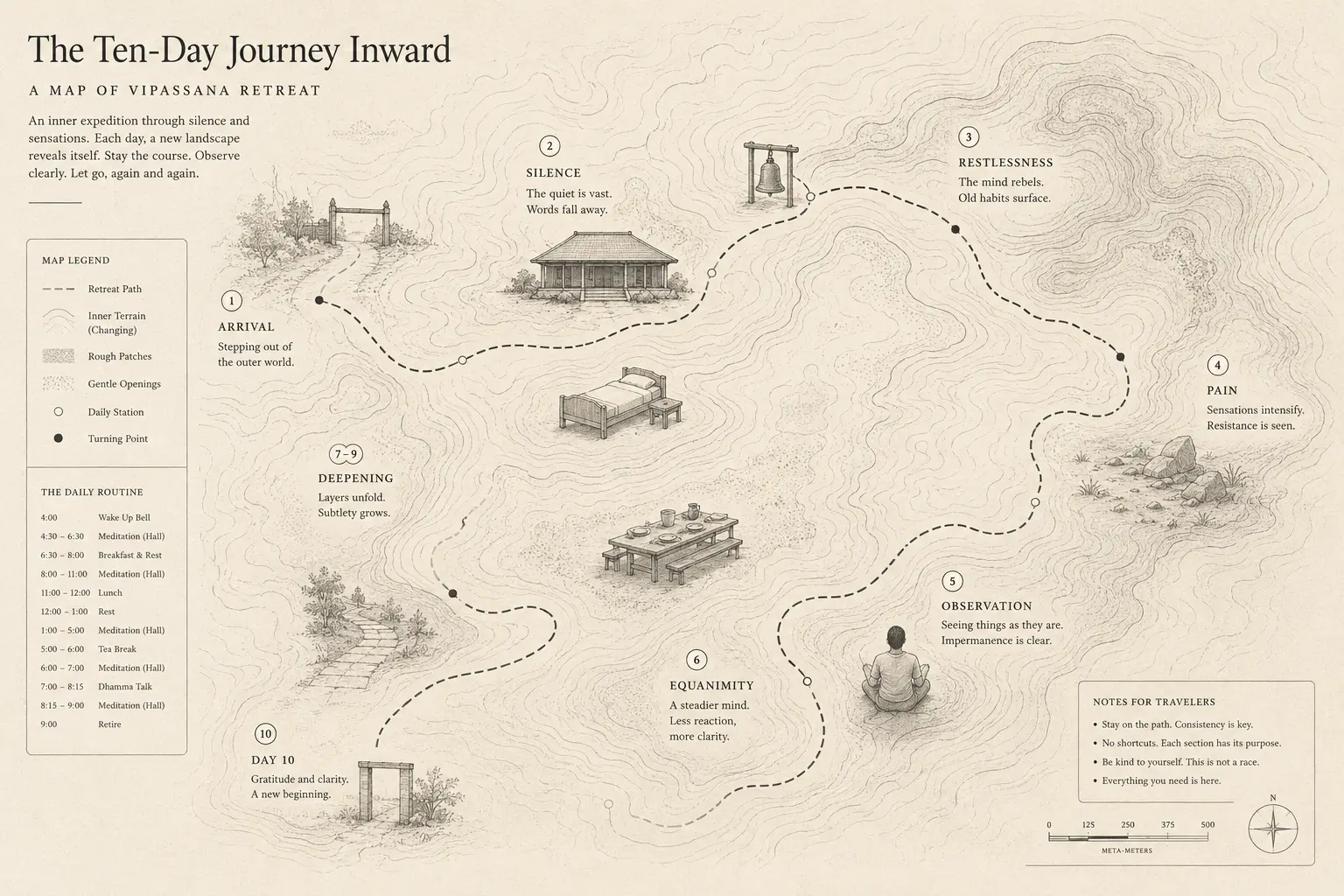
People cry. Quite a bit, actually. Old memories surface. Grief that was shelved for years makes an appearance. Some people feel euphoric. Some feel waves of anger or restlessness. Some feel nothing at all, which has its own flavor of frustration.
The teachers call this "sankharas" arising: old mental and emotional patterns stored in the body that get released during sustained practice. Whether or not you buy that framework, something does happen when you sit still with yourself for long enough without distraction.
You do not need to resolve everything that comes up. The instruction is simply to observe it, note the sensation, and return to the technique.
Food, Sleep, and the Practical Stuff
The food is vegetarian, simple, and surprisingly good at most centers. Breakfast usually includes oatmeal, fruit, and bread. Lunch is the main meal. New students also get fruit at the 5:00 PM break; returning students get only tea. This difference sounds small but feels significant by day six.
You sleep in simple dormitory-style accommodation or private rooms depending on the center. It is not a luxury retreat. The rooms are clean and functional. You will not need much because you will spend nearly all of your time either meditating or sleeping.
Phones and books are taken at the start. Reading and writing are discouraged during the course, though some centers are flexible on journaling. The idea is to remove anything that lets you escape into your head rather than observe it.
Who Should Go
Vipassana is not for everyone, and the centers will tell you this themselves. They ask that you not attend if you are currently dealing with severe depression, psychosis, or other acute mental health conditions. The practice can intensify what is already present, and without support, that can become destabilizing.
That said, people from every background attend. You do not need to be a meditator already. You do not need to be Buddhist or spiritual in any way. Many attendees are deeply skeptical going in. The technique is taught as a secular practice, even if its roots are religious.
If you are someone who values direct experience over belief, Vipassana tends to appeal to you. You are not asked to accept anything. You are asked to try the technique and observe what happens.
Day Ten: Breaking Silence
On the morning of day ten, noble silence ends. Students are encouraged to talk with each other before departure, partly to ease the transition back into daily life.
This part is strange in a good way. You have been surrounded by people for ten days without speaking to them, and now suddenly you are comparing notes. Everyone has had a completely different experience. Some had breakthroughs. Some found it mostly boring. Some had difficult stretches and came out the other side.
The consensus, from nearly everyone, is that it was worth it.
After the Retreat
The technique is meant to be practiced daily at home: one hour in the morning and one hour in the evening. Most people manage this inconsistently, which is fine. Even an irregular practice tends to shift something.
Some people return for a second or third course. Some attend longer retreats: 20 days, 30 days, or more, available to experienced students. The Dhamma center network is global, and once you have completed a ten-day course, you have access to that entire community.
If you want to understand what the research actually shows about what retreats do to your brain and stress response, the science behind retreat benefits is worth reading alongside your preparation.
Should You Go?
If you have read this far, you are probably already considering it. The cost is zero. The time investment is ten days. The potential upside: gaining a direct understanding of your own mind and a technique for working with it.
Book early. Courses fill up months in advance at popular centers. And go in with low expectations and a willingness to be uncomfortable. That combination tends to produce the best results.
The experience will not be what you imagine it will be. That is kind of the whole point.