
✓ Key Takeaways
- •Corporate retreats average $2,000 to $3,000 per employee all-in, split across seven core budget categories including venue, F&B, travel, and professional facilitation
- •82% of employees are at risk of burnout, costing companies up to $20,683 per executive per year and roughly $5 million annually for a 1,000-person organization
- •Under IRS Section 162, retreat costs are fully deductible when a primary business purpose is documented; meals are 50% deductible and recreational activities are not deductible
- •Well-designed wellness programs yield ROI of 150% to 380%, with benefit-to-cost ratios of $2.5:1 to $4.8:1
- •Standard commercial insurance does not cover wellness retreats; only clinically accredited programs treating documented conditions qualify for reimbursement
- •The 2026 MICE Report confirms that 71% of all corporate conferences now include at least one overnight stay
A corporate detox retreat is a structured multi-day offsite that removes employees from digital fatigue and operational burnout to reset cognitive performance, rebuild team trust, and reduce long-term healthcare costs. This guide covers everything your organization needs to plan one, budget it, deduct it, and measure its return.
Driven by permanent hybrid work models, record-high burnout rates, and a growing body of research linking in-person immersion to measurable performance gains, corporate Corporate Detox Retreats have become a primary tool for human capital retention and cultural alignment. The 2026 MICE Report confirms that 71% of all corporate conferences now include at least one overnight stay.
This guide covers the full picture: what corporate detox retreats are, how much they cost, how to structure the budget, what the IRS allows you to deduct, how burnout economics justify the investment, and what happens when planning goes wrong. It also answers the 30 most searched questions on this topic in one place.
What Is a Corporate Detox Retreat?
A corporate detox retreat is a structured multi-day offsite that removes employees from their daily operational environment specifically to recover from digital fatigue, address cumulative burnout, and reset cognitive and emotional performance. Unlike a standard strategy offsite, a detox retreat combines the business purpose of an offsite (alignment, collaboration, deep-focus work) with deliberate wellness programming: digital disconnection, movement, mindfulness, and restorative rest.
The broader category of corporate offsites uses specialized nomenclature based on strategic objectives. Understanding the taxonomy helps planners match the right format to organizational goals:
| Format | Primary Purpose | Typical Audience |
|---|---|---|
| Corporate / Team Offsite | Alignment, prioritization, cross-functional planning | Any department or function |
| Leadership / Executive Offsite | Strategic scenario planning, board alignment | Senior leaders, executive teams |
| Team-Building Retreat | Trust, communication, cohesion | Cross-functional or department teams |
| Tactical / Sprint Offsite | Solve a specific problem or complete a product roadmap | Product, engineering, growth teams |
| Workation | Blend structured work with restorative personal time | Remote-first companies |
Corporate detox retreats sit at the intersection of team offsite and wellness retreat: they carry a business agenda but prioritize restorative programming as the core mechanism for unlocking performance.
How Much Does a Company Retreat Cost?
Corporate retreats average $2,000 to $3,000 per employee all-in, once travel, lodging, meals, and planned activities are accounted for. Nightly accommodation alone typically runs $350 to $700 per person, per night. Budget planners should allocate spend across seven core categories:

| Budget Category | Share of Total | Notes |
|---|---|---|
| Venue and Accommodation | 35% to 45% | For groups of 30+, full property buyouts offer better per-person value than individual room bookings |
| Food and Beverage | 20% to 30% | On-site catering saves 10% to 15% vs. external restaurant buyouts for large groups |
| Travel and Transportation | 10% to 20% | Flights, airport transfers, and local ground logistics |
| Team-Building Activities | 10% to 15% | Outdoor adventures, facilitated exercises, cultural sessions |
| Facilitation and Programming | Variable | Professional workshop leaders typically charge €1,500 to €5,000 per day |
| AV and Technology | Variable | Specialized setups and hybrid event tech typically add €500 to €2,000 |
| Contingency Reserve | 5% to 10% | Covers late attrition, weather disruptions, and unexpected logistics costs |
How Long Should a Corporate Retreat Be?
The 2026 MICE Report shows that 71% of all corporate conferences and offsites include at least one overnight stay. Within that group, 37% choose a single night, 24% select two nights, and 10% opt for three or more nights. Only 29% remain day-only events. Duration should match strategic goals and organizational scale:
| Format | Duration | Cost per Person | Best For | Planning Window |
|---|---|---|---|---|
| Day Retreat | 4 to 10 hours | €75 to €150 | Tight budgets, localized teams, rapid quarterly checks | 2 to 4 weeks |
| 1-Night Retreat | 2 days / 1 night | €200 to €400 | Initial offsite programs, regional startups | 4 to 8 weeks |
| 2-Night Retreat | 3 days / 2 nights | €350 to €700 | Annual offsites, strategic alignment, cultural resets | 8 to 16 weeks |
| 3+ Night Retreat | 4+ days | €600 to €1,200+ | Executive boards, global kickoffs, change management | 16 to 24 weeks |
Tax Deductibility: Can You Write Off a Corporate Retreat?
The answer is yes, with conditions. Under IRS Section 162 and IRS Publication 463, corporate retreat expenses are deductible when they qualify as ordinary and necessary business expenses. The IRS requires documentation that establishes a primary business purpose, not a personal vacation dressed up with one business meeting.
The required documentation is: a formal written agenda, officially recorded meeting minutes, documented attendance logs, and a clear link to the company's strategic goals, professional development, or operational training.
| Cost Category | Deductibility | Key Rule |
|---|---|---|
| Commercial Flights and Transit | 100% deductible | Only if the trip is primarily business-oriented; if primarily personal, the fare is fully disallowed |
| Overnight Lodging | 100% deductible | For documented business days only; prorate if leisure days are mixed in |
| Professional Facilitation | 100% deductible | External workshop facilitators, guest speakers, and corporate trainers |
| Business Catering and Meals | 50% deductible | Bundled venue invoices must separate the meal portion from venue rental |
| Recreational Outings | 0% (not deductible) | Purely social entertainment, lavish dinners, and personal excursions |
| Spouse and Guest Expenses | 0% (not deductible) | Unless the guest is also a company employee |
The IRS also applies the Rule of Reasonableness: a facilitated strategic planning session with standard catered meals is fully acceptable, whereas writing off a $4,000-per-person dinner will likely trigger scrutiny. For multi-day retreats that combine business sessions with leisure days, all costs must be prorated based on the ratio of business days to total days.
Corporate Catering: How Much Does It Cost to Feed a Group?
Meal planning is a major cost variable that often surprises first-time retreat planners. Real-world pricing from two major US markets illustrates the range:
Philadelphia 2026 benchmarks: A light breakfast for 8 people averages $225. A sandwich platter lunch for 15 averages $300. A full meal setup for a 100-person all-hands averages $3,000. A staffed holiday party buffet for 75 guests averages $5,025.
Austin 2026 benchmarks:
| Service Format | Cost per Person | Best Headcount |
|---|---|---|
| Boxed Lunches | $16 to $28 | 10 to 100 |
| Drop-Off Buffet | $22 to $40 | 20 to 75 |
| Staffed Buffet | $38 to $66 | 50 to 200 |
| Family Style | $32 to $56 | 15 to 50 |
| Plated / Full-Service | $72 to $170+ | 20 to 150 |
Add on-site labor ($32 to $50 per hour per server, $40 to $60 per hour for bartenders) and equipment rentals ($5 to $14 per person). Seasonal events in Austin (SXSW, ACL) trigger price premiums of 15% to 30%.
For portion planning: breakfast requires 2 proteins, 2 grains, 1 starch, and 2 beverages per attendee; lunch requires 1 protein, 2 starches, 1 dessert, and 2 beverages; dinner requires 2 proteins, 2 starches, 2 vegetables, 1 dessert, and 3 beverages.
The Economics of Workplace Burnout
The financial case for corporate wellness investment starts with burnout. The Mercer Global Talent Trends report found that while 84% of employees report feeling energized at work, 82% are simultaneously at risk of developing burnout. This gap between short-term performance and long-term psychological sustainability represents a major risk to productivity, retention, and organizational continuity.

A study published in the American Journal of Preventive Medicine quantified the direct annual cost of burnout per employee across organizational levels:
| Employee Type | Annual Burnout Cost |
|---|---|
| Non-Managerial Hourly Employee | $3,999 per year |
| Non-Managerial Salaried Employee | $4,257 per year |
| Managerial Employee | $10,824 per year |
| Executive Leader | $20,683 per year |
For a standard 1,000-employee enterprise (59.7% hourly non-managers, 28.6% salaried non-managers, 10% managers, 1.7% executives), the aggregate annual cost of burnout reaches approximately $5 million. Burned-out workers also take 21% more sick days, compounding productivity losses further. The peer-reviewed evidence on what structured retreats actually do to cortisol, executive function, and sleep quality explains why immersive programmes outperform gym memberships and EAP offerings for high-burnout populations.
This seven-figure liability is precisely what drives corporate treasury and HR leaders to evaluate wellness programs as preventative cost-containment measures rather than optional perks.
Corporate Wellness Programs: Cost, ROI, and Platform Pricing
The average annual corporate wellness investment ranges from $150 to $1,200 per employee depending on organizational scale:
- Small businesses (under 50 employees): $150 to $400 per employee annually, primarily covering digital wellness apps and fitness tracking
- Mid-sized companies (51 to 1,000 employees): $400 to $800 per employee annually for outsourced health coaching, nutritional counseling, and digital platforms
- Large enterprises (over 1,000 employees): $800 to $1,200+ per employee annually for integrated systems, on-site fitness facilities, and biometric screening programs
Well-designed programs consistently yield benefit-to-cost ratios of $2.5:1 to $4.8:1, corresponding to an ROI of 150% to 380%. Wellhub client data shows that structured interventions produce up to a 35% reduction in overall healthcare claims.
Wellhub (formerly Gympass) operates on a dual-funding model. Companies pay a Per Employee Per Month (PEPM) administrative fee: $2 to $5 PEPM for enterprises over 1,000 employees, and $1 to $5 PEPM for smaller businesses. Employees then choose from 11 subsidized monthly subscription tiers, ranging from the free Digital plan (10 wellness apps including Headspace and MyFitnessPal) to Diamond at $344.99 per month (retail value $375, access to 20,000+ partners). Every paid plan from Starter includes up to eight personal training sessions per month. Companies that fund a baseline plan for all employees through the Wellhub+ program see utilization rates nearly double compared to opt-in-only models.
Will Insurance Pay for a Wellness Retreat or Coaching?
The short answer: no, for general wellness retreats; yes, under specific clinical conditions for intensive mental health programs.
Standard commercial health insurance does not cover wellness retreats focused on yoga, mindfulness, or spa relaxation, nor does it cover general wellness coaching. Coverage applies strictly to clinical mental health treatments such as Intensive Outpatient Programs (IOP) and Partial Hospitalization Programs (PHP), and only when all of the following apply:
- Medical necessity: A licensed physician or mental health professional documents that the patient's condition (Major Depressive Disorder, GAD, PTSD, or Bipolar Disorder) requires structured intensive therapy and that lower levels of care have proven insufficient
- Accreditation: The facility holds accreditation from CARF (Commission on Accreditation of Rehabilitation Facilities) or The Joint Commission (TJC)
- Clinical supervision: The program is led by a medical director and staffed by licensed healthcare professionals including psychiatrists, registered nurses, and licensed clinical social workers
- Evidence-based treatment: The program centers on CBT, DBT, or structured psychiatric medication management; holistic therapies are only reimbursable if integrated into a certified clinical plan
The ACA Medical Loss Ratio (MLR) rule requires individual and small-group insurers to spend at least 80% of collected premiums on direct medical claims and quality improvement. Large-group plans must meet 85%. Carriers failing to meet this threshold must refund excess premiums to policyholders. Some states are stricter: New York sets its small-group MLR at 82% and Massachusetts at 88%. This regulatory floor limits how much flexibility insurers have to expand discretionary wellness coverage.
The 7 Dimensions of Wellness in Corporate Programming
To build highly resilient workforces, corporate wellness strategies must address the multi-dimensional nature of human well-being. The International Council on Active Aging (ICAA) and the WHO define seven core dimensions:
| Dimension | Core Focus | Corporate Integration |
|---|---|---|
| Intellectual | Creative pursuits, lifelong learning, critical thinking | Educational subsidies, creative brainstorming spaces |
| Physical | Cardiovascular health, strength, sleep, nutrition | Gym subsidies, ergonomic workspaces, scheduled movement breaks |
| Emotional | Self-awareness, resilience, stress management | Employee assistance programs, mindfulness training, counseling |
| Social | Healthy relationships, community, communication | Collaborative workspaces, volunteering events, team-building offsites |
| Occupational | Work satisfaction, work-life balance | Flexible schedules, role clarity, transparent career growth paths |
| Spiritual | Personal meaning, values alignment, sense of purpose | Values-driven work, volunteer opportunities, quiet reflection spaces |
| Environmental | How surroundings affect personal health | Natural light, tidy workspaces, sustainability practices |
Some academic frameworks include an eighth dimension: Financial Wellness, covering budgeting, debt management, and financial security. Chronic financial stress is one of the primary drivers of workplace presenteeism, making it increasingly relevant in comprehensive corporate programs.
For intensive multi-day programming, organizations sometimes reference high-immersion models like Dr. Joe Dispenza's week-long advanced retreats, which run from 6:00 AM to 8:00 PM daily, combining neuroscience lectures with advanced meditation practices. Registration runs $2,499 to $2,699 USD, excluding lodging (starting at $294/night at host venues) and travel. A contrasting model is the Modern Elder Academy, which focuses on midlife career transitions at a more restorative pace, with program costs of $4,500 to $6,000 including all meals and accommodation.
What to Wear to a Corporate Retreat
Dress code is a practical concern that is consistently under-communicated to attendees. The right attire depends on the destination's climate, company culture, and planned activities:
| Dress Code | Men | Women | Setting |
|---|---|---|---|
| Business Casual | Chinos, button-downs, polo shirts, smart loafers | Tailored trousers, blouses, smart flats | Workshops, planning sessions, client-facing meetings |
| Smart Casual | Unstructured blazers, dark denim, leather sneakers | Simple dresses, structured knit tops, ankle boots | Evening dinners, social hours, receptions |
| Active-Casual | Moisture-wicking shirts, trail sneakers, light layers | Athleisure, performance leggings, sneakers | Hikes, team exercises, wellness sessions |
| Corporate Casual | Sweaters, slacks, derbies | Crewnecks, chinos, flats | Travel days, casual indoor workshops |
Key packing rules: bring a three-pair footwear plan (polished everyday shoe, athletic shoe, optional dressier option), choose wrinkle-resistant fabrics, and bring lightweight layers for air-conditioned rooms. Avoid political or graphic text, ripped clothing, hoodies during standard business hours, and pajamas in shared spaces. When in doubt, dress one level up: it is far easier to dress down a professional outfit than to dress up an overly casual one.
When Corporate Retreats Go Wrong: The Plex Story
Poor risk management can turn a corporate retreat into a liability event. The most documented example is the 2017 Plex retreat in Honduras.
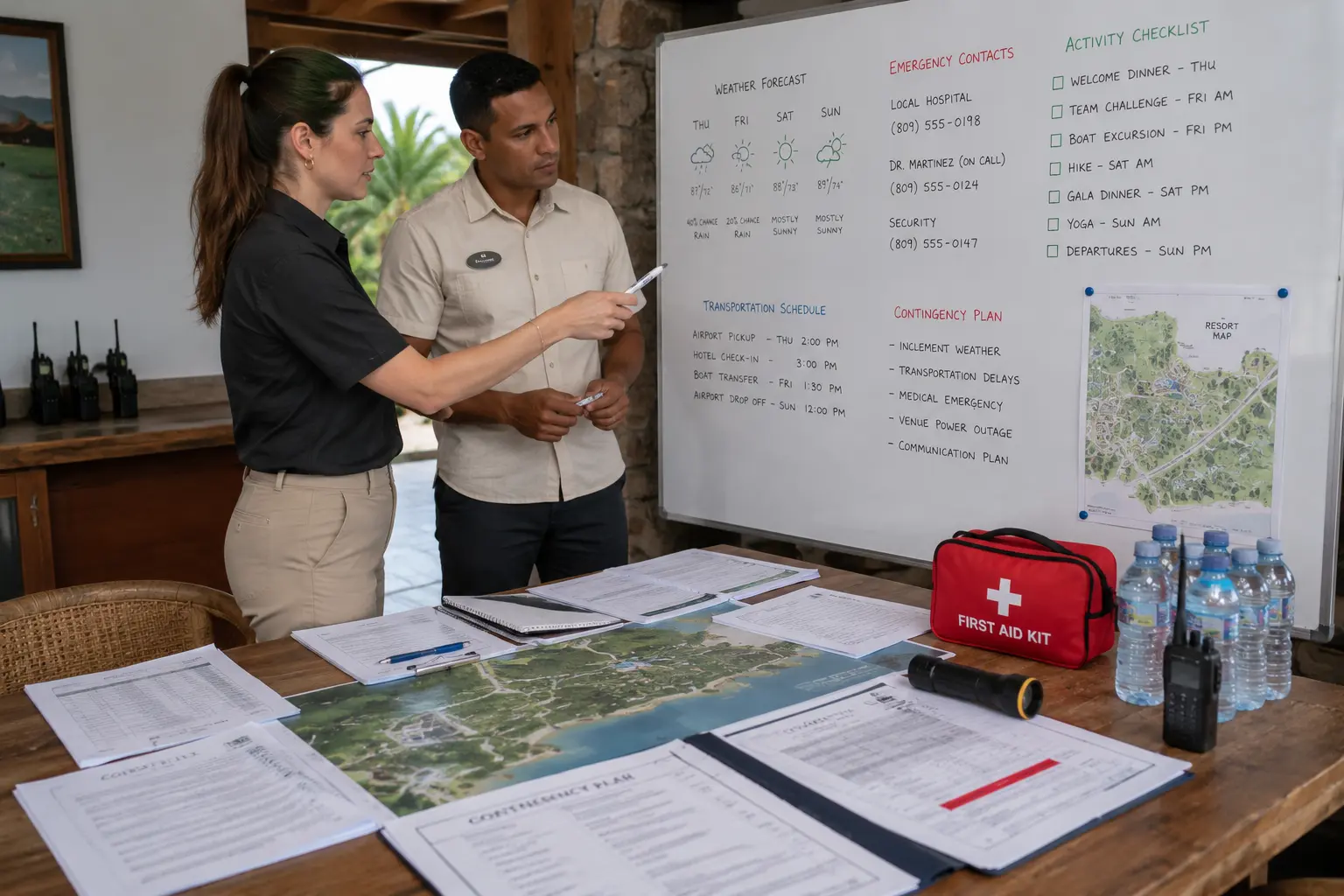
Streaming tech company Plex brought 120 remote employees to a resort for a week-long Survivor-themed event planned by Moniker Partners. Within hours, the retreat faced a cascade of failures. CEO Keith Valory contracted severe E. coli from a pre-arrival salad and spent the week hospitalized in his room on an IV. A former Navy SEAL led military-style drills on a 100-degree beach until employees passed out from heat exhaustion. Moniker's founder suffered severe heart palpitations from dehydration. Rooms lacked reliable water and electricity. An alligator appeared on the golf course. A porcupine fell through a guest room ceiling. A worker crawled into a fire ant mound during a beach drill. Several employees were stranded overnight on a neighboring island when local flights could not take off before dark. The opening team challenge required attendees to eat exotic insects, including a dead tarantula.
The retreat concluded without permanent injuries, but it illustrates how quickly extreme themes, inadequate vendor oversight, unverified venue infrastructure, and intense physical demands expose an organization to medical, legal, and reputational risk. The operational lessons are straightforward: verify medical access at the venue before booking, avoid extreme physical challenges with untrained participants, vet all local vendors, and maintain a 5% to 10% contingency reserve for the unexpected.