Yoga & Meditation
You Don't Need to Be a Yogi to Book a Yoga Retreat. You Just Need to Be Stressed.
✓ Key Takeaways
- •You do not need any yoga experience to benefit from a retreat - beginners often have the most transformative experiences.
- •Stress lives in the body, not just the mind, and a yoga retreat gives your nervous system permission to fully exhale.
- •Restorative, Yin, and Hatha yoga styles are the most beginner-friendly and effective for stress relief.
- •The destination is part of the healing - nature, climate, and culture all contribute to the retreat's restorative power.
- •Even a three-night weekend retreat can produce more rest and recovery than months of regular holidays.
- •The only question worth asking yourself is whether you are ready to give yourself a few days of genuine rest.
If you have never done yoga before, the idea of booking a yoga retreat probably sounds like something reserved for people who can touch their toes and wake up at 5am by choice. It is not. Some of the most powerful experiences people have on yoga retreats happen to complete beginners, people who showed up exhausted, skeptical, and with no idea what they were doing.
Why a Yoga Retreat Hits Differently Than a Regular Holiday
A regular holiday can be wonderful, but it is rarely restorative in the way the body truly needs. You are still making decisions, managing logistics, staying connected, and often coming home more tired than when you left.
A yoga retreat removes all of that. Someone else handles the food, the schedule, and the structure. Your only job is to show up. This might sound simple, but for people who spend their lives being responsible for everything and everyone, it is genuinely radical.
The combination of gentle movement, breathwork, and time in nature works on the nervous system in a way that little else can. Research published in Frontiers in Human Neuroscience found that participants in a yoga and meditation retreat experienced significant improvements in mindfulness and emotional regulation. For a deeper look at what the science actually shows, the evidence on retreat benefits covers the peer-reviewed data in detail. You do not need months for this to happen. Even a few days can shift something meaningful.
"Here is what nobody tells you about stress. It does not just live in your mind. It lives in your shoulders, your jaw, your chest, the way you hold your breath without realizing it."
The Best Types of Yoga Retreats for Stress Relief (Especially if You Are a Beginner)
Not all yoga is the same, and choosing the right style is important when your primary goal is stress relief rather than fitness or flexibility. If you want a fuller framework for matching retreat type to personal goal, the guide on how to choose the right wellness retreat covers the key criteria in plain terms.
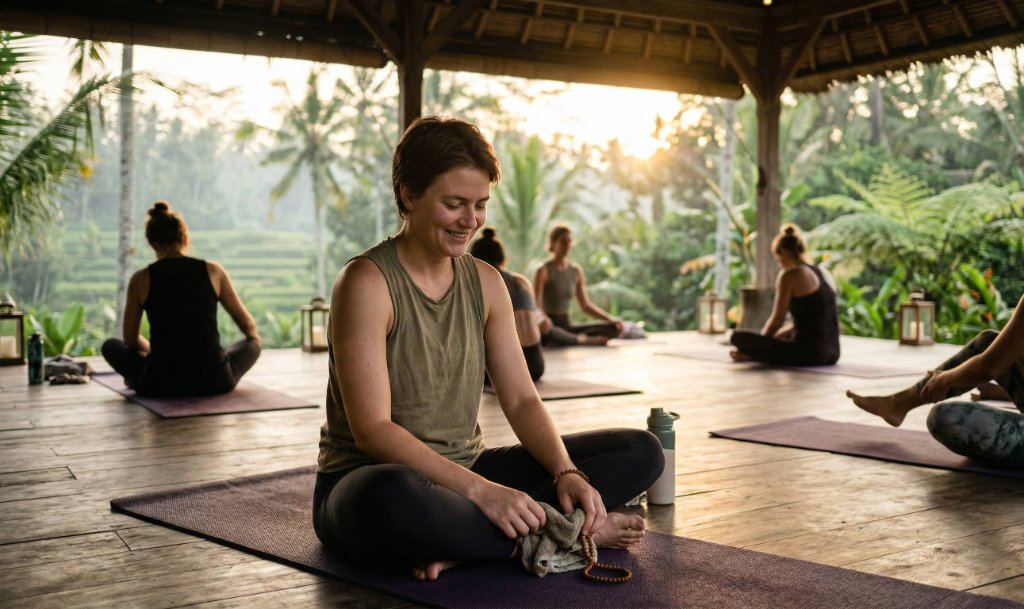
Restorative yoga retreats are the gentlest option and arguably the most effective for people who are truly burned out. In restorative classes, you hold soft, supported poses for several minutes at a time using blankets, bolsters, and blocks. There is no straining, no sweating, no performance. The body is held so completely that the muscles have no choice but to let go. For someone dealing with anxiety or chronic exhaustion, this kind of practice can feel like the first real rest they have had in years.
Yin yoga retreats are similar in pace but focus more on deep stretching of the connective tissue. Poses are slow and held for two to five minutes, and the practice has a meditative quality that quiets the mind alongside the body. Many people find yin yoga unexpectedly emotional, in a good way. When the body softens, so does whatever it has been holding.
Hatha yoga retreats are the most accessible starting point for beginners who want a gentle introduction to movement. Hatha focuses on basic postures, alignment, and breath. The pace is steady and unhurried, and a good Hatha teacher will always offer modifications so that every pose works for every body in the room. Most beginner-friendly retreats are built around a Hatha foundation.
Yoga and meditation retreats pair movement with mindfulness practice throughout the day. These programs often include guided meditation in the morning, a yoga session, free time in the afternoon, and a gentler evening practice. The rhythm of the day itself becomes a form of stress relief, and many people find that the meditation component stays with them long after the retreat ends.
"For someone dealing with anxiety or chronic exhaustion, restorative yoga can feel like the first real rest they have had in years."
Where to Go for a Yoga Retreat for Stress Relief
The destination matters. Nature is not just a backdrop on a yoga retreat. It is part of the medicine.
Bali remains one of the most beloved destinations in the world for this kind of experience, and for good reason. Ubud in particular has a quiet, spiritual quality that gets under your skin in the best way. The jungle, the rice fields, the sound of distant ceremony, the warmth of the people. Many first-time retreat guests describe Bali as a place where slowing down feels natural rather than forced. For a dedicated guide to Bali's yoga offerings, read the Bali yoga retreat guide.
Tulum in Mexico has built a genuine wellness community around its beautiful Caribbean coastline. Retreats here often weave in cacao ceremonies, cenote swims, and sound healing alongside yoga, creating a full sensory experience that feels a world away from office life. The warmth of the climate does its own work on a tense body.
Thailand, particularly the north around Chiang Mai, offers world-class yoga and meditation in a setting of mountains and jungle. The cost is lower than many other destinations, which makes it a smart option for first-timers who are not yet ready to commit to a premium price tag. The culture of mindfulness in northern Thailand runs deep and you feel it.
Portugal has quietly become one of Europe's best wellness destinations. The Alentejo countryside, with its cork forests and golden light, offers a surprisingly powerful setting for retreat. For anyone based in Europe who wants to avoid a long-haul flight, Portugal delivers the peace and natural beauty that make a retreat work without the jet lag.
Costa Rica is extraordinary for people who feel most restored by wild nature. Retreats set in the rainforest, near volcanoes, or on the Nicoya Peninsula put you in direct contact with an ecosystem so alive and loud and green that your own internal noise starts to quiet down by comparison.
What Actually Happens on a Yoga Retreat (For People Who Have Never Been)
This is the question most beginners are afraid to ask. Here is an honest answer.
You will wake up earlier than usual, typically for a sunrise or morning yoga session before breakfast. This is not as brutal as it sounds because you will also be going to sleep earlier, eating well, and not staring at a screen until midnight. Your body adjusts quickly.
The yoga classes on beginner-friendly retreats are genuinely accessible. Teachers at good retreats know how to read a room and will offer variations for every pose. Nobody is watching you, nobody is comparing, and nobody is going to ask you to do a headstand. The atmosphere in these classes tends to be warm and encouraging in a way that can be quite different from a studio back home.
The food is almost always a highlight. Most retreats serve wholesome, nourishing meals, often vegetarian or plant-based, that leave you feeling genuinely well rather than heavy. Many people notice changes in their digestion, energy, and sleep within the first two or three days simply because of the combination of good food, movement, and rest.
The afternoons are typically free. You can sleep, walk, swim, read, or simply sit somewhere beautiful and do nothing. This unstructured time is not wasted time. It is often where the real unwinding happens.
You will meet people. Most guests at yoga retreats are there alone, which means there is a shared openness that makes connection easy. You are all in the same position, all looking for something similar, and none of the usual social performance applies.
"This unstructured time is not wasted time. It is often where the real unwinding happens."
How Long Should Your Yoga Retreat for Stress Be
A weekend retreat of three nights is enough to feel a real difference. Many people describe coming back from a weekend retreat feeling more rested than they have in months. That said, if you can manage five to seven days, the impact goes deeper. The first day or so is usually just decompression, the process of your mind and body letting go of their usual pace. The transformation tends to happen from day three onward.
If you are uncertain, start with a weekend. You will likely come home already thinking about the next one.
The Only Question Worth Asking Before Your Yoga Retreat
Not "am I flexible enough" or "do I know enough about yoga" or "will I fit in." The only question is whether you are ready to give yourself a few days of genuine rest and see what happens when you do.
Most people who have been on a yoga retreat will tell you the same thing. They wish they had gone sooner.
"Most people who have been on a yoga retreat will tell you the same thing. They wish they had gone sooner."
Browse yoga retreats for stress relief and beginners at Retreator and find the one that feels right for you.